





46
Day it starts
Your license suspension is automatic
On the 46th day after the notice you were handed at your arrest, the Secretary of State suspends your license. It happens on its own, separately from your criminal case, and no court date stops it. To stop the suspension before it starts, the petition to rescind has to be filed and heard inside that 45 day window.
Check where you stand
Three Questions About Your Case
Tell us what you are facing and we will show you which parts of Illinois law apply and how many days you have left on your license.
- Your situation
- The details
- Where you stand
What are you facing?
Choose the one that fits best.
Choose a situation to continue.
Does any of this apply?
Choose all that apply, or skip if none do. These change what the statute allows.
When were you arrested?
Your license suspension starts on the 46th day after the arrest date.
Enter your arrest date, or skip to see your summary without a deadline.
What applies to your situation
- A first DUI is a Class A misdemeanor under 625 ILCS 5/11-501, carrying up to 364 days in jail and fines to $2,500. Court supervision is available on a first offense, and supervision is not a conviction.
- Court supervision is not available on a second or subsequent DUI. A third offense is a Class 2 felony carrying three to seven years, and revocation runs five years on a second conviction and ten on a third.
- Causing great bodily harm makes a DUI a felony regardless of offense number, under 625 ILCS 5/11-501(d). Where a crash causes a death, the charge becomes DUI homicide, carrying three to 14 years for one death and six to 28 years where two or more people are killed.
- Illinois charges DUI for cannabis, controlled substances, and prescription medication. A prescription taken exactly as directed by a doctor is not a defense to the charge.
- Illinois applies zero tolerance to drivers under 21, so any measurable amount of alcohol supports a three month suspension on a first offense, or six months if the driver refuses testing. A separate DUI conviction revokes driving privileges for two years rather than one.
- A suspension expires on its own once the term runs and the fee is paid. A revocation does not expire at all, and ends only after a Secretary of State hearing restores your privileges.
- Refusing testing doubles a first offender’s suspension from six months to twelve, and a driver who is not a first offender faces three years with no driving relief. Refusal does not stop the State from prosecuting, and it can be raised at trial as evidence of consciousness of guilt.
- A BAC of 0.16 or higher adds mandatory minimum penalties on top of the base offense, including additional fines and community service on a first offense.
- Transporting a passenger under 16 adds substantial mandatory fines and can elevate the charge to aggravated DUI.
- Commercial drivers are held to a 0.04 threshold rather than 0.08, and a Monitoring Device Driving Permit does not allow driving a commercial vehicle.
- Driving with no valid license, or on a license already suspended or revoked for a DUI-related reason, elevates a DUI to aggravated DUI under 625 ILCS 5/11-501(d).
- The DUI statute is not limited to cars. Charges reach bicycles, watercraft, and recreational vehicles, each with different licensing consequences.
A lawyer can tell you what these mean for your case specifically.
Call (630) 261-9098or have us reach out
FreeConfidentialNo obligation
This summary is general information about Illinois law based on what you selected. It is not advice about your case, and it does not predict any outcome. Every case depends on its own facts.
Start here
What Kind of DUI are You Facing?
DUI is not one charge. What you were driving, what was in your system, and how many prior offenses you have all change the exposure and the strategy.
This is my first DUI
A Class A misdemeanor. Court supervision is on the table, and it avoids a conviction entirely.
I have prior offenses
A third DUI is a felony. Supervision is no longer available and revocation runs for years.
It involved drugs, cannabis, or a prescription
You can be charged for medication taken exactly as prescribed. Cannabis carries its own THC threshold.
Someone was hurt
Great bodily harm or a death moves the case into felony territory with mandatory prison exposure.
I refused the test
Refusal doubles the suspension to twelve months, and the State can still prosecute without a reading.
I need my license back
A revocation does not expire. It ends only after a Secretary of State hearing goes your way.
All DUI Topics We Cover
By driver status
License and process

Your DUI attorney
Patrick J. Weiland
Managing Partner · Criminal Defense
Pat spent nearly ten years as an Assistant State’s Attorney in DuPage County before he began defending these cases. He supervised the felony trial division and trained police officers on the same roadside procedures those officers use today.
That background does not give a client influence over anyone’s decision. It gives them a lawyer who knows how a DUI file gets assembled, which weaknesses the prosecutor already knows are in it, and where the State’s own procedures leave room to push.
Former DuPage prosecutor
Spent nearly ten years prosecuting DUI and felony cases for DuPage County
Supervised the felony trial division
Trained police officers on the roadside procedures they still use today
As your defense attorney
Defends DUI charges in DuPage, Cook, Kane, Will, and Kendall Counties
Files and argues petitions to rescind license suspensions
Represents clients at Secretary of State reinstatement hearings
You are Facing Two Cases, Not One
Most people arrested for DUI in DuPage County expect a court date. What surprises them is the letter from the Secretary of State.
A DUI arrest triggers a criminal prosecution and a separate administrative action against your driver’s license. They run at the same time, on different clocks, in front of different decision makers. The criminal case is heard at the DuPage County Courthouse in Wheaton. The license case belongs to the Illinois Secretary of State, and it does not wait for the criminal case to finish.
The two outcomes are independent. You can be found not guilty of DUI and still lose your license. You can keep your license and still be convicted. Handling one well does nothing for the other.
Two cases, two clocks
The criminal charge decides whether you have a record and whether you serve jail time. The statutory summary suspension decides whether you can drive. A defense that only answers the criminal charge leaves the license case unanswered.
What happens to your license, and when
Illinois has an implied consent law. By driving here, you have already agreed to submit to breath, blood, or urine testing if an officer arrests you with probable cause. That consent is found at 625 ILCS 5/11-501.1.
A first offender who fails a chemical test faces a six month suspension. A first offender who refuses testing faces twelve months, double the penalty for failing. Drivers who are not first offenders face a year for failing and three years for refusing, with no driving relief available at any point.
A first offender is issued a Monitoring Device Driving Permit unless they go to court to decline it. The permit allows driving at any time and for any purpose in a vehicle fitted with an interlock device under 625 ILCS 5/6-206.1. The device has to be installed within 14 days of the permit being issued, and if the Secretary of State receives no notice of installation, the permit is cancelled. Commercial license holders cannot use the permit for a commercial vehicle, and drivers who are not first offenders do not qualify for any driving relief at all.
The 45 day window closes fast
A petition to rescind has to be filed and set for hearing before the suspension takes effect if it is going to stop it. In many DuPage County cases the hearing can be scheduled alongside your first court date, but only if the petition is filed early.
The mechanics of the statutory summary suspension, the Secretary of State hearing process, and the interlock requirements work differently depending on your record, and MDDP eligibility turns on whether this is genuinely your first offense as the statute defines it.
Not sure how many days you have left?
Give us the date on your arrest paperwork and we will tell you where you stand.
What the State Has to Prove
Illinois defines the offense at 625 ILCS 5/11-501, and there are two common ways to charge it.
The first is a number. A blood alcohol concentration of 0.08 or higher is enough on its own for most drivers. Commercial drivers are held to 0.04. Drivers under 21 are held to zero under the state’s zero tolerance law.
The second is impairment. A driver below 0.08 can still be charged if the State believes it can prove impairment from alcohol, drugs, or a combination. Between 0.05 and 0.08 the law gives you no presumption either way, so the case turns on what the officer observed and recorded.
One point catches people out. The statute reaches anyone driving or in actual physical control of a vehicle. Keys in the ignition of a car that never moved can support a charge.
Penalties by Offense Number
Illinois DUI penalties escalate steeply. Each additional offense raises the classification, lengthens the revocation, and narrows what a judge is permitted to consider.
1
First offense
Class A misdemeanor. Up to 364 days in jail, fines to $2,500, minimum one year revocation on conviction. Supervision available.
2
Second offense
Class A misdemeanor with a mandatory minimum of five days in jail or 240 hours of community service. Five year revocation within 20 years.
3
Third offense
Class 2 felony, charged as aggravated DUI. Three to seven years in prison, fines to $25,000, ten year revocation.
4
Fourth offense
Class 2 felony. Revocation is permanent, and neither probation nor supervision is available.
5
Fifth offense
Class 1 felony carrying four to 15 years in prison, lifetime revocation, fines to $25,000.
6
Sixth or subsequent
Class X felony carrying six to 30 years. The most serious classification short of first degree murder, and it cannot be probated.
Fines increase further where your BAC was 0.16 or higher, or where you were transporting a passenger under 16. A single stop often produces more than one charge, and illegal transport of an open container carries its own penalty on top of the DUI.
Repeat offenses and fatal crashes are where Illinois DUI sentencing reaches its outer limits. Offense number is only one route to a felony. 625 ILCS 5/11-501(d) lists circumstances that elevate a DUI to aggravated DUI regardless of whether it is your first, including causing great bodily harm, driving without a valid license or insurance, and driving on a license already suspended or revoked for a DUI-related reason. Where a crash causes a death, the charge becomes DUI homicide.
The Evidence, and Where It Comes Apart
A DUI file is built from a short sequence of observations and tests, each of which has to be performed correctly to mean anything.
Roadside field sobriety tests are standardized procedures with specific instructions and scoring. Officers who deviate from the protocol produce results that do not carry the weight the report suggests.
The preliminary breath test at the roadside is a screening tool, and its result is not admissible at trial to prove your BAC. The evidentiary chemical test at the station is the one that counts, and it depends on a calibrated machine, a certified operator, and a properly observed waiting period.
Alcohol absorbs over a period after the last drink, so a reading taken an hour after a stop may not reflect your BAC while you were actually driving. That gap is the basis of the rising BAC defense. The stop itself is equally open to challenge, though DUI checkpoints operate under different rules. There are a number of ways DUI cases fall apart, and which apply depends entirely on what the reports and the video show.
Have your police report and video reviewed
Most of what decides a DUI case is in the discovery file, not the courtroom.
How a DUI Case Moves Through DuPage County Court
DUI cases here are heard at the DuPage County Courthouse, 505 North County Farm Road in Wheaton, home of the 18th Judicial Circuit. Misdemeanor DUI is typically handled in the misdemeanor and traffic division. Felony DUI goes to the felony division.
Arrest and release
You are given a citation, a notice of statutory summary suspension, and a court date. The paperwork starts the 45 day clock.
Arraignment
Your first appearance, where the charge is read and a plea is entered. For misdemeanor DUI this typically takes place in traffic court.
Petition to rescind
Filed and heard on the license side, ideally before the suspension takes effect. Where the first court date falls late, the hearing is often requested sooner.
Discovery
Police reports, squad and body camera video, breath machine records, and calibration logs. Most of what decides a case is found here.
Pretrial motions
Challenges to the stop, the arrest, or the admissibility of test results. A successful motion can end the case without a trial.
Alcohol and drug evaluation
DuPage County requires an evaluation through County Court Services before sentencing. It classifies your risk level and shapes what the court is asked to order.
Disposition
Supervision, a plea to a reduced charge, a negotiated sentence, or trial. What is realistically available depends on your record and the evidence.
Who Prosecutes Your Case Changes What is Possible
Not every DUI in DuPage County is prosecuted by the same office. Some are charged by the county and handled by the DuPage County State’s Attorney. Others are charged under a municipal ordinance and handled by a village prosecutor.
Naperville, Downers Grove, and Elmhurst each run their own prosecutions in some cases, and offices differ in how they evaluate a file, what they are willing to negotiate, and how they weigh an evaluation result. A case that resolves one way in one courtroom can resolve differently a few miles away.
Supervision, Conviction, and Your Record
For a first offense, court supervision is often the outcome that matters most. Supervision is not a conviction. Complete the conditions the court sets and the case ends without a DUI conviction entering your record.
That distinction is permanent, because Illinois does not allow a DUI conviction to be expunged or sealed. Once it is there, it stays. Reduction to a lesser charge, most often wet reckless, is negotiated rather than guaranteed, and what is achievable depends on the evidence and your history.
How court supervision works, what shapes a DUI plea negotiation, and how long a DUI stays on your record are each worth understanding before you decide how to approach your case. Conditions such as community service and vehicle impoundment frequently form part of a sentence.
What a Conviction Costs After the Case Ends
A conviction appears on background checks, which affects employment and hits commercial drivers hardest. It raises auto insurance premiums sharply and can cost you coverage. It has to be disclosed on many college and financial aid applications. For anyone who is not a citizen, it can carry immigration consequences well beyond the sentence.
These follow a conviction, not a charge. That is the practical argument for taking a first offense seriously.
Getting Your License Back
A suspension expires on its own once the term runs and the fee is paid. A revocation does not expire at all. It ends only when the Secretary of State restores your privileges, and that requires a hearing, an alcohol and drug evaluation, and any remedial education the evaluation recommends. The full reinstatement process takes longer than most people expect.
What clients say
60+ Five-Star Google Reviews
I couldn’t be more grateful to Pat for helping me through my DUI case. From the very beginning, he was honest, responsive, and genuinely cared about the outcome. He walked me through every step, answered all my questions, and got my case dismissed! … I highly recommend him.
Pat Weiland is probably one of the nicest most knowledgeable and helpful Lawyers servicing DuPage county…. I have had my fair share of run in with Law Enforcement and just got my case resolved. Thank you sir!
Una firma de abogados sería, honesta,profesional, me sentí muy seguro de que me ayudarían en mi caso de DUI, en el cual lucharon por mi inocencia y el resultado fue excelente. No salí culpable veredicto final del Juez, NOT GUILTY, (no culpable) gracias Dolci/Weiland.
These reviews were posted by clients on Google and appear as written. Every case is decided on its own facts, and the results described here do not predict the outcome of any other case.
DUI Lawyers Near You
We handle DUI cases throughout DuPage County and the surrounding counties, with frequent representation in communities such as:
Naperville
Wheaton
Lombard
Carol Stream
Downers Grove
Glen Ellyn
Elmhurst
Addison
Villa Park
Bloomingdale
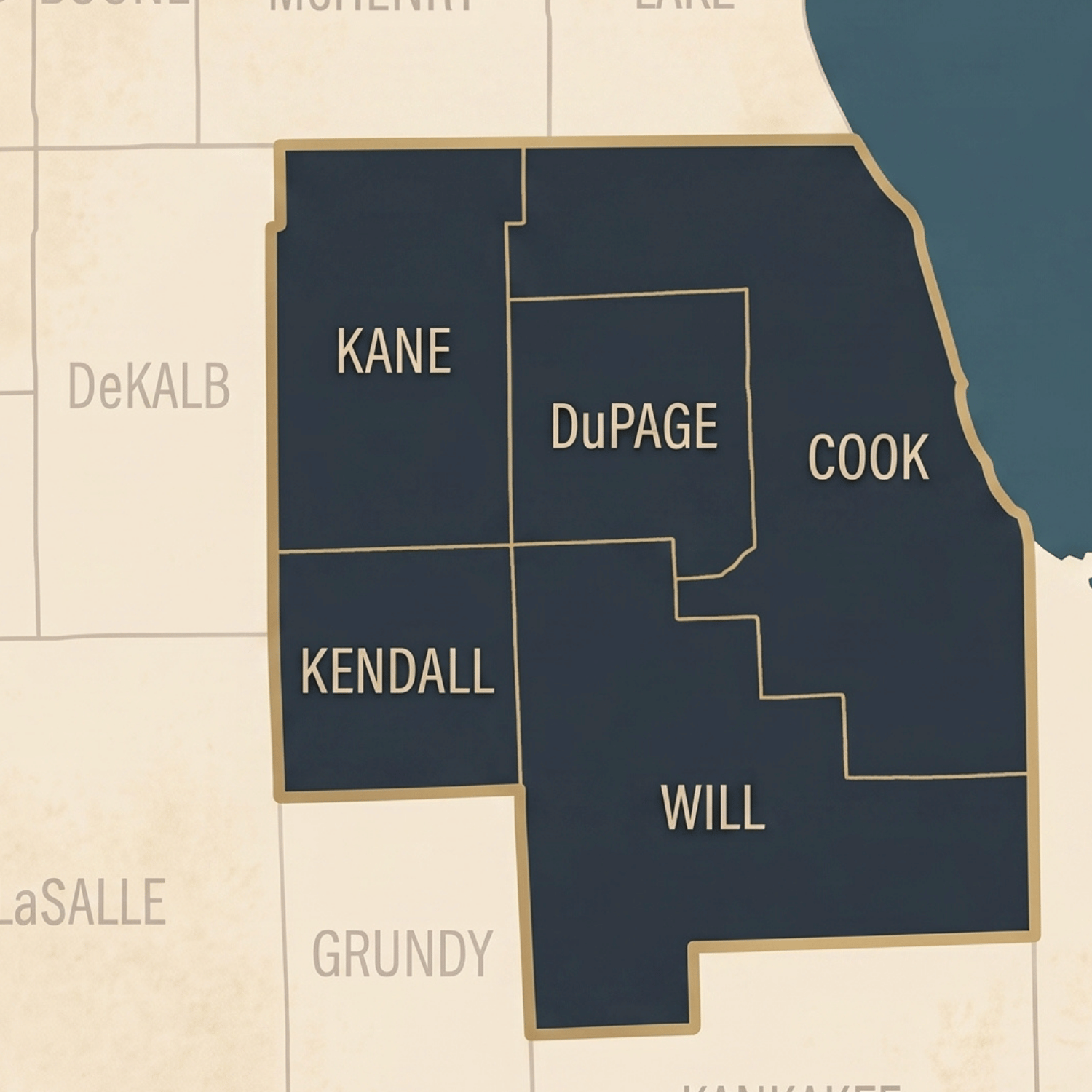
Also nearby: Bolingbrook, Aurora, St. Charles, Elgin, Joliet, Yorkville, and Oswego
Most of our DUI cases are heard at the DuPage County Courthouse in Wheaton, home of the 18th Judicial Circuit. When a stop happens across the county line, we also handle cases in the Kane, Will, Kendall, and Cook County courts.
Local practice varies across the county. Which department stopped you, how it runs its DUI arrests, and how that municipality’s cases tend to move through Wheaton all shape what happens next, whether the stop was in Naperville, Elmhurst, Lombard, Carol Stream, or Downers Grove. Call us at (630) 261-9098 and tell us where you were pulled over, and we will explain what to expect there.
DUI Questions We Hear Most
Not immediately. The statutory summary suspension takes effect on the 46th day after you are served notice, which is normally the night of the arrest. You keep driving privileges during those 45 days, which is the window for filing a petition to rescind.
That depends on what you are trading. Refusing leaves the State without a chemical test result, which can make the criminal charge harder to prove. It also carries the longer suspension, twelve months rather than six for a first offender and three years rather than one for anyone who is not, and it can be raised at trial as evidence of consciousness of guilt.
Neither suspension is automatic. It holds only if the officer had reasonable grounds to arrest you and read you the Warning to Motorist, and a petition to rescind can challenge that. Refusal also does not stop the State from prosecuting using the officer’s observations, the squad video, and the field sobriety tests.
Yes. A driver below 0.08 can be charged with impairment under 625 ILCS 5/11-501 if the State believes it can prove impairment from alcohol, drugs, or both. Under 21, any measurable alcohol is enough.
No. Illinois does not permit a DUI conviction to be expunged or sealed. Court supervision, which is not a conviction, is the outcome that keeps a DUI conviction off your record in the first place.
Yes. The statute covers driving or being in actual physical control of a vehicle. Sitting in a parked car with access to the keys has supported charges.
DUI cases arising in DuPage County are heard at the DuPage County Courthouse at 505 North County Farm Road in Wheaton. Misdemeanor DUI is typically handled in the misdemeanor and traffic division, and felony DUI in the felony division.
Fees depend on whether the case is a misdemeanor or a felony, whether the license suspension is contested, and whether the case goes to trial. We discuss fees directly at the free consultation so you know the figure before you decide anything.
You speak with someone at the firm, not a call center. We ask what you were charged with and when you were arrested, so we can tell you where your license deadline sits. If we can help, we set a consultation. If your matter belongs somewhere else, we say so.
Talk to a DUI lawyer before day 46
Your consultation is free. The sooner we see the paperwork from your arrest, the more options stay open on both cases.
Or call us directly: (630) 261-9098